How Head to Head works
We compare two products or product types head to head, giving you a real verdict on which is the better choice for your situation — and exactly when to choose each one.
Front-Clip vs Back-Clip Dog Harness: Which Is Right for Your Dog?
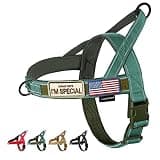
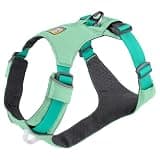
Annchwool No Pull Dog Harness with Soft Padded Handle,Reflective Strip Escape Proof and Quick Fit to Adjust Dog Harness,Easy for Training Walking for Small & Medium and Large Dogs(Green,M)
Redirects pullers without a collar — the training harness

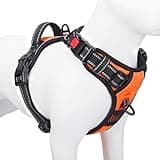
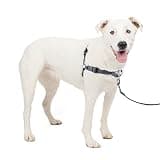
PHOEPET No Pull Dog Harness Medium Reflective Front Clip Vest with Handle
Comfortable, natural movement for dogs that walk nicely
Our verdict — Front-Clip Harness wins
For most dogs that pull — which is most dogs — the front-clip harness is the right choice. When a dog lunges forward, the front attachment point redirects them sideways toward you rather than letting them use their chest to drag ahead. This does not fix pulling on its own, but it gives you real control during walks and makes training significantly easier. Back-clip harnesses are comfortable and well-suited to dogs that already walk calmly on a loose lead, but they give a determined puller a structural advantage they will absolutely use.
Buy Front-Clip Harness if…
Your dog pulls on the lead, lunges, or is still in lead training — which covers the majority of dogs.
Buy Back-Clip Harness if…
Your dog already walks calmly on a loose lead and you want a comfortable harness for daily walks or active exercise.
You spend forty minutes researching harnesses online, pick one with good reviews, clip it on, and your dog drags you down the street exactly as hard as before. The problem was never the harness quality — it was the clip position. Where the lead attaches to the harness determines whether you are working with your dog's pulling instinct or directly against it, and a back-clip on a dog that pulls is the equivalent of buying a sled harness and wondering why the dog keeps sledding.
A front-clip harness has a D-ring on the dog's chest. When the dog pulls, the lead redirects the dog sideways instead of letting them power straight ahead. A back-clip harness has a D-ring between the shoulder blades. The lead sits out of the way and allows a natural, unrestricted stride — which is exactly what you want once pulling is no longer the problem. Both designs come in padded, adjustable, step-in, and overhead varieties, and neither is inherently better. The right one depends entirely on what your dog does at the other end of the lead.
This article breaks down how each clip position works, where the real differences show up during daily walks and active exercise, and which harness to buy first for your dog in 2026. By the end you will know whether a front-clip or back-clip dog harness fits your situation — and when a dual-clip option makes the decision unnecessary.
What is a Front-Clip Dog Harness?
A front-clip harness routes the lead attachment to a D-ring at the centre of the dog's chest, roughly at the sternum. When the dog pulls forward, the lead creates lateral pressure that turns the dog's body sideways toward the handler rather than allowing them to continue pulling in a straight line. The dog has to pause, reorient, and start walking again — which interrupts the pulling cycle without any correction from you. The physics of the attachment point does the redirecting; you hold the lead and walk normally.
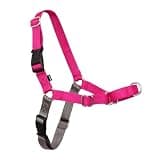
Key specs to consider are strap width (wider distributes pressure better and reduces rubbing on short-coated breeds), adjustability (look for at least four adjustment points — two on the chest panel, two on the belly strap — to get a secure flat fit), and whether the chest strap sits below the point of the shoulder rather than across it. A strap that rides up into the armpit area or crosses the shoulder joint can restrict gait over time. Padding matters on the sternum panel especially for dogs under 10kg where the strap-to-body contact area is small.
Front-clip harnesses are the right starting point for any dog that pulls on the lead, any puppy learning lead manners for the first time, and any reactive dog where you need reliable redirection during lunges. They are also the better option for owners who lack the upper body strength to hold a large dog that surges forward — the redirection means you are steering the dog rather than bracing against it.
What is an Back-Clip Dog Harness?
A back-clip harness places the D-ring between the dog's shoulder blades, centred on the back. The lead attaches behind the dog's centre of gravity and sits out of the way during movement. There is no strap across the chest restricting shoulder rotation, no lateral redirection when the dog moves ahead, and no pressure on the sternum. The dog walks with a completely natural gait, and the lead stays clear of the legs — which is why back-clip designs are the default for sport harnesses, running harnesses, and service dog equipment.
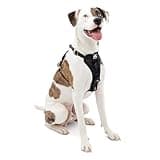
When buying, focus on the back panel design (a Y-shaped front avoids pressure on the trachea), whether the harness is step-in or overhead (step-in suits dogs that resist having things put over their head), and whether the padding sits flat under the belly strap without bunching. Weight distribution matters more than it seems: a poorly balanced back-clip harness shifts sideways during movement and creates hot spots. For dogs over 25kg, look for load-rated hardware — stamped steel buckles rather than plastic side-release clips that can pop open under a sudden lunge.
Back-clip harnesses are the right choice for dogs that already walk on a loose lead without pulling, for running and canicross where full shoulder extension matters, and for small breeds where a chest strap would be disproportionately restrictive. They are also the more comfortable option for dogs that wear a harness all day — during travel, in dog-friendly offices, or on long hiking days where the harness stays on for hours.
Key Differences
Pros & Cons
Front-Clip Harness
- ✓Redirects a pulling dog sideways instead of letting them power forward — gives you steering control without yanking or correcting
- ✓Makes lead training significantly faster because the dog learns pulling is unproductive rather than just uncomfortable
- ✓Safer for reactive dogs — a sudden lunge turns the dog toward you rather than launching them at the trigger
- ✗Requires precise fitting to avoid shoulder restriction — a chest strap that rides up can affect gait over time
- ✗Not suitable for running or high-intensity exercise where the dog needs full shoulder extension at speed
Back-Clip Harness
- ✓Allows completely natural shoulder movement — no chest strap interfering with gait during walks, runs, or sport
- ✓More comfortable for extended wear during travel, hiking, or all-day use without causing rub points
- ✓Simpler to fit correctly — the back attachment is more forgiving of minor sizing errors than a sternum-mounted D-ring
- ✗Provides zero pulling control — a dog that pulls in a back-clip harness is biomechanically in a sled harness
- ✗No redirection for reactive dogs — a lunge goes straight forward with the dog's full body weight behind it
Pulling control
A front-clip harness has a D-ring at the dog's sternum. When the dog pulls forward, the lead creates lateral tension that turns the dog's body sideways. The dog cannot continue pulling in a straight line — it has to reorient. Over time, most dogs reduce the pulling behaviour because it produces this interruption. The physics of the attachment does the work; you do not need to yank or correct.
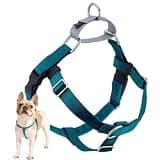
A back-clip harness attaches between the shoulder blades. When the dog pulls, the lead creates rearward pressure along the same axis the dog is already pulling along. There is no redirection. Sled dog harnesses use exactly this design because it maximises forward pulling force. Buying a back-clip harness for a dog that pulls is, biomechanically, buying a sled harness.
For the majority of pet dogs — and trainers consistently estimate that 70–80% of untrained dogs pull to some degree — this single difference is the entire decision. If your dog pulls, the front-clip gives you a mechanical advantage that no amount of leash technique replicates with a back-clip. Start with a front-clip, train loose-lead walking using the redirection as your foundation, and reassess once the pulling is under control.
Comfort and fit
Back-clip harnesses are more forgiving to fit and more comfortable for the dog during long walks. Because the lead attachment is on the back, there is no strap across the chest that could cause rubbing or shoulder restriction. For a dog that already walks well, the back-clip provides a natural range of motion that most dogs prefer.
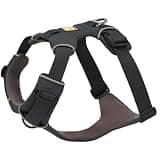
Front-clip harnesses require more precise fitting. The sternum strap must sit flat on the chest — not twisted or riding up toward the throat. A poorly fitted front-clip can restrict shoulder movement and affect gait over time. Check fit carefully, adjust regularly on growing dogs, and watch for any asymmetry in how your dog moves. This is a legitimate concern, not a reason to avoid front-clip — just a reason to fit it properly.
If your dog wears a harness for extended periods — long hikes, travel days, or all-day wear in a dog-friendly workplace — the back-clip's comfort advantage compounds over hours. A well-padded back-clip with a Y-shaped front panel distributes load evenly and stays in position without constant readjustment. For dogs with sensitive skin or thin coats, this matters more than the clip position debate suggests.
Running and active exercise
The back-clip harness allows full shoulder extension at running pace, which makes it the better choice for canicross, jogging, agility training, and any activity where the dog needs free movement. The lead attachment sits out of the way and does not interfere with the natural stride.
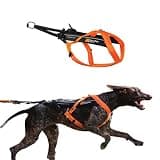
Front-clip harnesses can restrict shoulder rotation at speed. For high-intensity exercise or running alongside your owner, the sternum strap limits how far the dog's front legs can reach on each stride. Use the front-clip for training walks and daily lead work, then switch to a back-clip or dedicated sport harness for exercise sessions where you want the dog moving freely.
Dogs that do both — daily walks where pulling is still a work in progress and weekend runs or hikes — benefit from owning one of each. Use the front-clip for structured walks and training sessions, switch to the back-clip for off-lead-friendly trails and running routes. A dual-clip harness with both front and back D-rings is a practical alternative if you prefer not to swap harnesses between activities.
Which to buy first
If you are buying a harness for a dog that pulls — which covers the majority of dogs — buy the front-clip. You can always move to a back-clip once lead manners are established. Going the other direction (starting back-clip and switching when pulling becomes a problem) just means buying two harnesses.
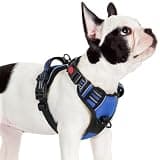
If you are buying for a puppy, start with a front-clip. Puppies learn quickly that pulling is unproductive when the attachment creates lateral redirection. Establishing this habit early makes every subsequent walk easier. Some harnesses offer dual attachment points — both front and back — which is a sensible option if you want flexibility across different situations.
The exception is a dog that genuinely does not pull and never has — some breeds, some temperaments, some dogs that came to you already trained. For these dogs, start with a back-clip and enjoy the simplicity. There is no benefit to a front-clip harness on a dog that walks on a loose lead. You are buying a training tool for a dog that does not need training, and the chest strap is an unnecessary restriction on an otherwise comfortable walk.
Can You Use One Instead of the Other?
For dogs that walk calmly on a loose lead, either clip position works and the choice is purely about comfort. A front-clip harness on a non-pulling dog functions as a normal harness — the redirection mechanism only activates when the dog pulls, so a well-behaved dog will not notice the difference. In this specific case, a back-clip is slightly better because it avoids the chest strap entirely, but a front-clip is not causing any problem.
The substitution breaks down completely in the other direction. A back-clip harness on a dog that pulls gives you no mechanical advantage. You are holding the lead while the dog powers forward with their full chest against the harness — exactly the configuration that sled harnesses are designed to optimise. No amount of leash technique, treat distraction, or verbal correction compensates for the biomechanical reality that you are working against the strongest pulling position the dog has. For reactive dogs that lunge at triggers, a back-clip can be genuinely dangerous because the full force of a sudden lunge transfers directly to your arm.
If you want one harness that covers both scenarios, buy a dual-clip harness with D-rings at both the chest and the back. Clip to the front for training walks and structured lead work, clip to the back for runs and off-lead-friendly hikes. This is the practical answer for most owners, and several well-regarded harnesses now include both attachment points at no extra cost over a single-clip design.
Related Tools Worth Knowing
- ›
Head Halter — When a front-clip harness is not enough — for large, powerful dogs that still pull hard despite chest redirection, a head halter gives you control at the head.
- ›
Dual-Clip Harness — When you want one harness for both training walks and running — front and back D-rings in a single design eliminate the need to own two separate harnesses.
- ›
Dog Collar with ID Tag — When your dog walks perfectly on a loose lead and you only need a lead attachment for legal compliance or ID — lighter and simpler than any harness.
- ›
Dog Harness for Medium Dogs→ — When you need a general-purpose harness sized for 10–25kg breeds — the most common size range where fit and strap width matter most.
Our Top Picks
Best Front-Clip Harness
Best Dual-Clip Harness
Ready to buy? Check current prices below
Redirects pullers without a collar — the training harness
PHOEPET No Pull Dog Harness Medium Reflective Front Clip Vest with Handle
Comfortable, natural movement for dogs that walk nicely
Frequently Asked Questions
Can a front-clip harness hurt a dog's shoulders?▾
A correctly fitted front-clip harness should not restrict shoulder movement. The chest strap should sit below the point of the shoulder, not across it. If it rides up or the fit is too tight, it can cause rubbing and potentially affect gait over time. Check fit regularly, especially on growing dogs.
Will a front-clip harness stop my dog pulling completely?▾
No harness stops pulling on its own. The front-clip reduces the effectiveness of pulling and makes control easier, but consistent lead training is still required. Think of it as a tool that creates better conditions for training, not a substitute for it.
My dog hates putting on a harness — does the clip position make a difference?▾
Some dogs dislike the process of putting on any harness. Look for a slip-on or overhead design where the dog puts their head through first rather than stepping into leg holes. Most dogs adapt quickly once the harness is on; the resistance is usually about the fitting process, not the harness itself.
Can I use a front-clip harness for running with my dog?▾
Not ideally. The sternum strap can restrict natural shoulder extension at running pace. For canicross or jogging, a back-clip harness or a dedicated running harness is more appropriate. Use the front-clip for training walks, and switch to back-clip for exercise sessions.
My dog has a deep chest and narrow neck — will a standard harness fit?▾
Deep-chested breeds like Greyhounds and Whippets are difficult to fit with standard harnesses. Look for harnesses specifically for sighthounds or deep-chested dogs, which have a different neck-to-chest ratio. Both clip types are available in these specialist fits.
Conclusion
For most dogs, the front-clip harness is the right first purchase — it gives you mechanical control over pulling that no back-clip design can replicate, and it creates the conditions for lead training to actually work.
If your dog already walks on a loose lead without pulling, get a back-clip harness for the comfort and unrestricted movement. If your dog pulls and you also want to run or hike together, get a dual-clip harness and use the front attachment for training walks and the back attachment for exercise. The decision framework is simple: pulling problem means front-clip, no pulling problem means back-clip, both situations means dual-clip.
Check the top picks above for the best current options in each category. A well-fitted harness in the right clip position will change your daily walks more than any amount of training treats or YouTube tutorials — start with the right tool and the training follows.
More Comparisons
Related Rankings
See the full ranking
←10 Best Dog Harnesses for Medium Dogs of 2026