How Head to Head works
We compare two products or product types head to head, giving you a real verdict on which is the better choice for your situation — and exactly when to choose each one.
Neckband Earbuds vs True Wireless Earbuds: Which Should You Buy in 2026?
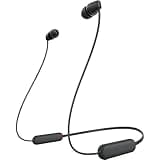
Sony WI-C100 Wireless in-Ear Bluetooth Headphones with Built-in Mic, Black
25-hour battery, magnetic pause, and a microphone that actually picks up your voice

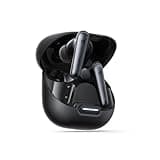
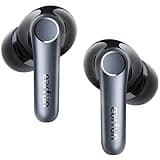
Soundcore by Anker Liberty 4 NC Wireless Earbuds
No cable anywhere — and ANC that neckbands at this price cannot match
Our verdict — True Wireless Earbuds wins
True wireless earbuds are the better choice for most buyers in 2026 — they offer active noise cancellation at prices neckbands cannot match, a genuinely pocketable case, and modern codec support that improves audio quality over Bluetooth. Neckband earbuds fight back in specific areas: they last 20–25 hours on a single charge without needing a case, their microphones perform better on calls because the boom sits closer to your mouth, and there is no risk of losing a £30 earbud down a drain. The right answer depends on whether you care more about ANC and portability, or battery stamina and call reliability.
Buy Neckband Earbuds if…
You make frequent calls, work from home on video calls, exercise intensively outdoors, or need a full day of battery without access to a charging case.
Buy True Wireless Earbuds if…
You commute in noisy environments, switch between devices, care about audio quality, or want the most portable everyday listening experience.
The most common mistake people make with this decision is buying true wireless earbuds because they look modern, then spending half their workday charging them. Neckband earbuds last two to three times longer on a single charge — 20 to 25 hours compared to the 6 to 10 hours most true wireless earbuds offer — and their microphone sits closer to the mouth, which makes a meaningful difference on calls.
True wireless earbuds have their own decisive advantages. Active noise cancellation is now available on true wireless models from around £55; below £100, neckband earbuds almost never include ANC at all. The charging case extends total battery to 30+ hours, the absence of any cable is genuinely more comfortable for most people, and modern codec support — LDAC and aptX — produces noticeably better audio quality over Bluetooth.
This guide covers the neckband earbuds versus true wireless earbuds comparison in full: battery life, noise cancellation, call performance, gym use, and value in 2026 — so that by the end you will know which type fits your situation and which specific scenario makes the other the right call.
What is a Neckband Earbuds?
Neckband earbuds consist of a flexible band or cable that rests around the neck, with wires running up to each earpiece. The band houses the battery, Bluetooth chip, and microphone — because the battery sits in a larger enclosure than an earbud case, manufacturers can fit significantly more capacity. The result is 20–25 hours of playback on a single charge, with no companion case required to reach the end of the day. Most models charge via USB-C and support magnetic pause, which stops playback when you snap the earbuds together at the chest.
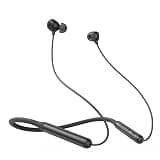
The specs that matter when buying are battery capacity (look for 20+ hours), microphone placement (chest-level boom mics outperform in-ear mics for call clarity), whether the earpieces support magnetic pause, and water resistance rating (IPX4 covers gym use and light rain). Codec support at budget price points is typically SBC and AAC — rarely LDAC or aptX. If high-quality Bluetooth audio is a priority, this is where neckbands fall short of the better true wireless alternatives.
Neckband earbuds are the right choice for people who make frequent calls, forget to charge things, exercise intensively, or need reliable all-day playback without a case. The one consistent complaint is wearability: the band stays around your neck even when you are not listening, which suits some situations and not others.
What is an True Wireless Earbuds?
True wireless earbuds contain the battery, Bluetooth chip, microphone, and drivers entirely within each earbud — no wires, no neckband, nothing connecting the two sides. The companion charging case recharges the earbuds between sessions and typically adds 20–30 hours of capacity on top of the 6–10 hours in each pair. The case is pocketable in a way no neckband can match, and modern true wireless earbuds include features — active noise cancellation, wireless charging, multipoint Bluetooth, LDAC support — that neckband earbuds at the same price do not offer.
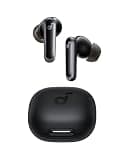
Key specs to evaluate: total battery including the case (not just per-charge time), whether ANC is adaptive or fixed (adaptive adjusts to your environment; fixed applies one level regardless), codec support (LDAC for high-quality Android streaming, AAC for iPhone), and fit system (stability wings versus ear tips only — matters for gym use). Wireless charging and multipoint Bluetooth appear at budget price points on true wireless earbuds; neckband earbuds rarely offer either.
True wireless earbuds are the right choice for commuters in noisy environments, listeners who care about audio quality, and anyone who wants a clean everyday carry without a cable visible. The main drawbacks are daily charging, the need to bring the case, and loss risk — replacing a single dropped earbud typically costs £20–40.
Key Differences
Pros & Cons
Neckband Earbuds
- ✓20–25 hours of continuous playback on a single charge — no case needed to reach the end of the day
- ✓Chest-level microphone produces noticeably better call clarity than in-ear mics — significant advantage for remote workers
- ✓No loss risk — if an earpiece comes loose during exercise, it hangs from the cable rather than falling to the floor
- ✗Active noise cancellation is almost entirely absent below £100 — a decisive gap for commuters and office workers
- ✗The neck cable is always present — less comfortable for situations where you want to fully remove your earphones between uses
True Wireless Earbuds
- ✓Adaptive ANC available from around £55 — cuts ambient noise in ways neckband earbuds at this price cannot match
- ✓LDAC and aptX support on budget models delivers audibly better audio quality on high-quality Bluetooth streaming
- ✓Genuinely pocketable case extends total battery to 30+ hours and adds wireless charging on mid-range models
- ✗6–10 hours per charge is less than half the neckband's stamina — daily charging is required for all-day users
- ✗Individual earbuds can be lost or fall out during sport — replacement typically costs £20–40 per side
Battery life
Neckband earbuds deliver 20–25 hours of continuous playback on a single charge. The Sony WI-C100 hits 25 hours; a ten-minute quick charge adds another hour. True wireless earbuds last 6–10 hours before needing the case. If you forget the case, you have whatever charge is left in the earbuds — typically half a workday.
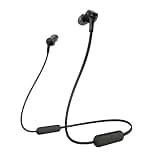
Long-term, neckbands also age better. True wireless earbuds charge daily — 350+ cycles per year. Neckbands charge every few days, around 100 cycles. After two years, battery degradation is noticeably worse on true wireless earbuds. It is why old AirPods and Galaxy Buds die fast while equivalent neckband earbuds from the same era are still going strong.
For the occasional listener who charges their device every night anyway, the battery difference is academic — most people do not need more than 8 hours of playback in a single stretch. The gap becomes decisive in specific situations: a long-haul flight without a power outlet, a full workday of calls followed by a commute and gym session, or outdoor use where charging access is limited for days at a time. If you regularly use earphones for 12+ hours in a day, neckband earbuds solve that problem permanently.
Noise cancellation
Active noise cancellation is almost entirely absent from neckband earbuds below £100. True wireless earbuds have offered adaptive ANC from around £55 since 2024. The Soundcore Liberty 4 NC adds LDAC codec support, wireless charging, and multipoint Bluetooth at that price — features neckband earbuds at double the cost simply do not match.
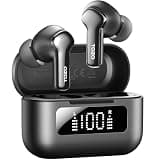
For commuters, office workers, or anyone in noisy environments, this gap is decisive. Budget ANC will not match premium over-ear headphones, but it meaningfully cuts air conditioning hum, traffic, and office chatter. LDAC support also produces audibly better results on streaming services that offer high-quality audio — it is a real improvement, not a spec sheet number.
The neckband's only answer to ANC is passive isolation — the physical seal of the ear tip against the ear canal. A good ear tip fit provides 15–20dB of isolation, which reduces background noise somewhat but is nothing like the 25–40dB reduction that even budget ANC delivers when switched on. If you regularly work in open-plan offices, travel on public transport, or study in shared spaces, passive isolation alone is not enough — and ANC is the single feature most likely to make true wireless earbuds the right choice regardless of any other consideration.
Call quality
The neckband microphone sits at chest level — close to your mouth, stable, and shielded from wind. Call recipients consistently rate neckband earbuds higher for voice clarity. True wireless mics sit in the earbud, which introduces variability depending on ear tip fit, earbud orientation, and wind exposure. Budget true wireless earbuds often sound thin to callers in louder environments.
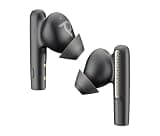
For occasional calls the difference is manageable. For remote workers on Teams or Zoom for two or more hours daily, neckband earbuds are the more reliable choice. The magnetic pause feature adds a practical workflow bonus — snap the earbuds to your chest and playback stops instantly, no need to reach for your phone between calls.
The best-performing true wireless earbuds for calls use beamforming microphone arrays to focus on the voice signal and reject background noise — and the best of them are competitive with neckband earbuds in quiet environments. But the quality floor is lower: budget true wireless earbuds in noisy conditions often sound distant or muffled to callers. If a significant part of your day involves professional calls — client meetings, support roles, sales — the neckband's consistently higher microphone floor is the lower-risk choice.
Gym and sport
The neckband's cable weight holds earpieces in place during exercise more reliably than the friction-only fit of true wireless earbuds. Most neckband models are rated IPX4 for sweat resistance. If a neckband earbud comes loose during a run, it dangles from the cable. If a true wireless earbud falls out, it is gone — replacement earbuds cost £20–40 per side, and some manufacturers do not sell them separately at all.
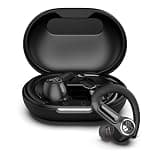
True wireless earbuds with sport-specific wing tips can hold in place reliably for gym use. If you train indoors and are willing to choose a sport-specific model, true wireless is viable. For high-intensity outdoor running or anyone who has already lost an earbud, the neckband removes the risk entirely.
For gym use specifically — lifting weights, cardio machines, yoga, indoor classes — true wireless earbuds with a secure sport fit work reliably for most people. The risk is lower indoors because even a dropped earbud on a gym floor is recoverable. The calculation changes for road running: a true wireless earbud falling into a puddle or drain mid-run is not recoverable, and replacement is expensive. If outdoor running in variable weather is a primary use case, the neckband removes that risk and typically costs significantly less than the sport-specific true wireless alternative.
Can You Use One Instead of the Other?
For casual music listening and podcasts in a quiet environment, the type of earbuds matters less than buyers assume. Either format delivers acceptable audio quality at budget price points, and either can handle calls adequately if the environment is not too noisy. A neckband can substitute for true wireless in every scenario except active noise cancellation, which it simply cannot replicate below £100.
True wireless earbuds cannot substitute for neckband earbuds in two specific scenarios: all-day battery without a charging case, and professional-level call quality in variable environments. If you commute for two hours each way, work from home all day on calls, and then exercise in the evening — 12+ hours of use — a true wireless earbud will not last without recharging mid-session. Similarly, if clients or colleagues are assessing you on call clarity in noisy conditions, the chest-level neckband microphone is genuinely different to an in-ear mic.
Some people own both and switch by situation — neckband for gym days and work calls, true wireless for commuting with ANC. This is a reasonable approach if the budget allows, as the price points overlap: a decent neckband and a budget ANC true wireless pair can be acquired for around £80–100 combined. For most buyers choosing a single pair, the decision comes down to whether ANC matters more than battery stamina and call quality — and the answer to that question is usually clear once it is framed directly.
Related Tools Worth Knowing
- ›
Over-Ear Headphones — When you need longer ANC sessions, higher audio quality, or all-day comfort without the in-ear fatigue that earbuds cause on extended listening.
- ›
Sports Earphones with Ear Hooks — When both neckband and true wireless earbuds keep falling out during exercise — dedicated sport earphones with stabiliser hooks solve the fit problem without the neck cable.
- ›
Bone Conduction Headphones — When you need to stay aware of traffic or your surroundings during outdoor running — bone conduction delivers audio without blocking the ear canal.
- ›
Wired Earbuds→ — When audio quality or zero latency matters more than wireless convenience — and when battery life should never be a concern.
Our Top Picks
Best Neckband Earbuds

Best True Wireless Earbuds
Ready to buy? Check current prices below
Sony WI-C100 Wireless in-Ear Bluetooth Headphones with Built-in Mic, Black
25-hour battery, magnetic pause, and a microphone that actually picks up your voice
Soundcore by Anker Liberty 4 NC Wireless Earbuds
No cable anywhere — and ANC that neckbands at this price cannot match
Frequently Asked Questions
What is the difference between neckband earbuds and true wireless earbuds?▾
Neckband earbuds have a flexible band that sits around the neck with wires running to each earbud. True wireless earbuds have no wires at all — each earbud is completely independent. The neckband houses a larger battery (typically 20–25 hours), while true wireless earbuds use a charging case to extend their shorter per-charge life (typically 6–10 hours).
Which is better for calls — neckband or true wireless earbuds?▾
Neckband earbuds. The microphone sits at chest or collar level, close to the mouth, in a stable position that does not shift with ear tip fit. Call recipients consistently rate neckband earbuds higher for voice clarity. For occasional calls the difference is minor, but for heavy call users — remote workers, people on video calls frequently — neckband is the more reliable choice.
Do true wireless earbuds have active noise cancellation at a budget price?▾
Yes, and this is one of the biggest reasons true wireless earbuds have the edge for most buyers. Options like the Soundcore Liberty 4 NC offer adaptive ANC at around £55–70. Neckband earbuds below £100 almost never include ANC. If noise cancellation matters to you, true wireless is the only realistic option at a budget price.
Can you replace a single lost true wireless earbud?▾
Sometimes, but it is not guaranteed. Some manufacturers sell individual replacements — Sony and Apple do in most regions — but pricing is typically £20–40 per earbud, and support is often discontinued after a few years. Neckband earbuds eliminate this problem: if an earpiece comes loose, it hangs from the cable.
Are neckband earbuds outdated in 2026?▾
Not functionally. They still lead on battery life, microphone quality, and loss resistance. They have fallen behind on ANC and modern codec support. If you judge by appearance, true wireless is the modern choice. If you judge by practical needs — all-day battery, call clarity, gym reliability — neckband earbuds are underrated and frequently the better value.
Conclusion
True wireless earbuds are the stronger choice for most buyers in 2026 — ANC at budget prices, modern codec support, and a pocketable case make them the more versatile format for everyday use.
If you make frequent calls, exercise heavily outdoors, or need 12+ hours of battery without recharging, the neckband earbuds' advantages are real and not trivially solved by the alternatives. The decision is genuinely simple once framed: ANC and portability point to true wireless; call quality and battery stamina point to neckband.
Check the top picks above for the best current options at each price point. If you are unsure, the Soundcore Liberty 4 NC covers most situations well at its price; if calls and gym use are priorities, the Sony WI-C100 or Soundcore Life U2i are consistently underrated values.
Related Rankings
See the full ranking
←10 Best Wireless Earbuds Under $40 of 2026